

Purity Seed Tests
We offer a full complement of purity testing services based on both AOSA and ISTA seed testing rules. We can also classify purity results based on schemes used for OECD, Australia, New Zealand or Canada.
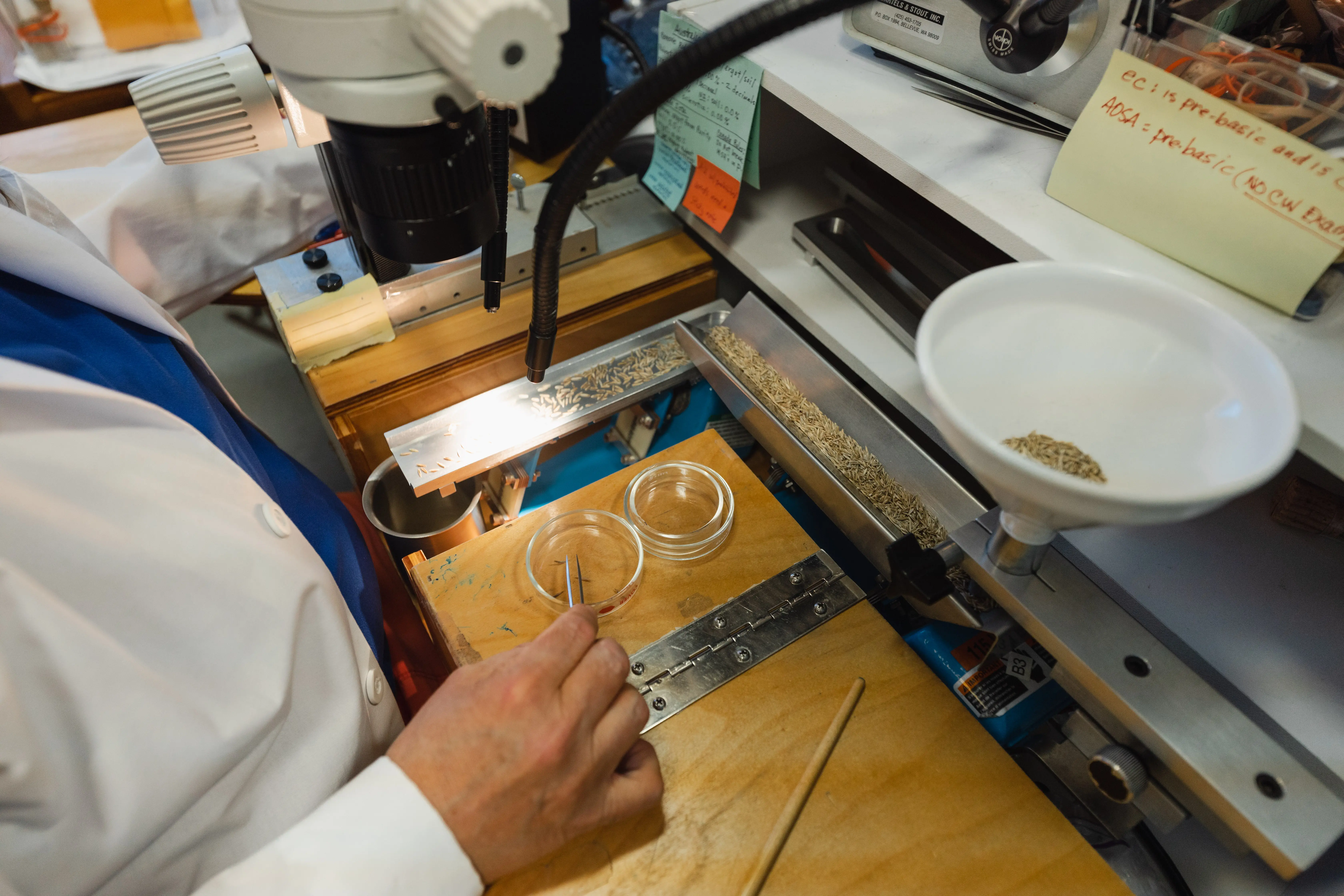
AOSA Purity Test (p) This test determines the percentage by weight of pure seed, other crop seeds, inert matter, and weed seeds in a test sample (minimum 2500 seeds). This test can be conducted on commercial, certified, official, and other samples. When a customer orders an AOSA purity test, the lab also conducts and reports an all-states noxious weed exam, see below.
AOSA Noxious Weed Exam (nox): This test reports the name and number of any noxious weed seeds found in a test sample (minimum 25,000 seeds) based on the Federal all-states noxious-weed seed requirements. A noxious exam for a particular state such as Hawaii or Wisconsin can be performed as well. The test does not report other seeds that are not in the noxious list. The noxious exam is required by the Oregon Certification Program and is automatically conducted when an AOSA purity is ordered.
Undesirable Grass Seeds (ugs): The UGS test is an examination of a test sample (minimum 25,000 seeds) for ten species deemed undesirable in seven eastern states (MD, VA, WV, PA, NJ, NH and DE). These species are bentgrass, bermudagrass, annual bluegrass, rough bluegrass, meadow fescue, tall fescue, orchardgrass, redtop, timothy, and velvetgrass. When marketing turf varieties into the listed states, the seed label must list the name and number per pound or ounce of UGS species found in a test sample under the heading "Noxious Weed Seed" or "Undesirable Grass Seed". This test can be conducted on commercial, certified, or official samples.
Oregon Sod Quality Exam (sq): (Certification eligible samples only.) Search for specific crops and weeds as defined by the program. Sod tests sequential meaning that they are stopped if disqualifying contaminants or amounts of contaminants are found. Please see the Oregon Sod Quality page for more information.
AOSA Crop & Weed Exam (cw): This exam provides a complete listing of all species (both crops and weeds) found in a test sample (minimum 25,000 seeds) and categorizes the seeds as crop seeds or weed seeds. Both the actual number of seeds found in a test sample (e.g., 1 seed in 50g) and the rate of occurrence (number of seeds per pound) are reported. Because the CW test provides complete listing of all the seeds found in a test sample, Oregon Sod Quality and UGS reports can be generated in most cases without testing the sample again, saving time and money for customers. This test can be conducted on commercial, certified, official or other samples. It is required for Certified AOSA/EC basic and pre-basic tagging, Canada testing, and WA Sod Quality.
ISTA Purity Test (ista/p): This test determines the percentage by weight of pure seed, other seeds, and inert matter. The minimum sample size is 2500 seeds (see the ISTA Rules for more details). ISTA Orange and Blue Certificates can only be issued for species listed in the ISTA Rules, Chapter 2, Table 2A within the scope of the Lab's Accreditation. This test can also be reported on an OSU Report of Analysis.
ISTA Other Seed Determination (OSD): (also called Determination of Other Seeds by Number) This test determines the number and identity of other seeds in a test sample. (see the ISTA Rules for more details). ISTA Orange and Blue Certificates can only be issued for species listed in the ISTA Rules, Chapter 2, Table 2A within the scope of the Lab's Accreditation. This test can also be reported on an OSU Report of Analysis.
The extent of this determination is referred to as the scope of the test. The scope depends on customer needs:
- Complete (comp/osd) in which the whole working sample (minimum 25,000 seeds) is searched for all other seeds present (this equates to the AOSA C&W exam).
- Limited (limit/osd) in which the search is restricted to stated species in the whole working sample.
- Reduced (red/osd) in which only part of the working sample is examined for all other seeds.
- Reduced-Limited (red/limit/osd) in which only part of the working sample is examined for stated species only.
ISTA Other Seed Determination (au): Australia accepts test reports from ISTA accredited laboratories that are approved by AQIS (Australian Quarantine and Inspection Service). Otherwise, the shipment is held at the port for quarantine until it is sampled, tested and evaluated for acceptance or rejection. This creates delays. Additionally, if the lot is rejected, you are required to re-clean it or ship it back, which would result in significant losses.
- If Glyceria spp. are found in Oregon grass seeds, the Glyceria is ploidy tested by flow cytometry or PCR to further specify because G. declinata is acceptable and other Glyceria spp. are not. (See BICON import conditions for more information.)
ISTA Other Seed Determination (nz): New Zealand accepts test reports from ISTA accredited laboratories.
AOSA Soil Exam (s) / ISTA Soil (ista/s): Determines the percentage of soil particles in the working sample. Can be performed as a sequential test (i.e. other tests will be done only if soil exam results are within a certain specification).
Pest and Disease Exam (p&d): The working sample is examined for a list of pests and diseases. Affected seeds are removed, identified, weighed and reported by percentage.
Orobanche Test (orob): Determines the presence of Orobanche seeds in a submitted sample of red clover using a dry method. This test requires its own sample.
Ergot (ergot): A test to detect Ergot (Claviceps purpurea) in a sample. The ergoted seeds are removed, weighed and reported as percentage.
Friction Separation Exam (fs/ex): Certified alfalfa and red clover samples must be tested for dodder or any other Oregon prohibited weeds. A 500g bulk examination is required for certification purposes.
Noxious/Prohibited Tests for Other Countries (n): A test performed at customer request. The noxious weeds list varies with the country. The customer must provide a current list of noxious/prohibited weeds of the particular country.
Test Weight (wt): This test helps in determining the seeding rate. Seed weight can indicate seed size, density, and the presence of shriveled, small, less developed seeds in a lot. Depending on the variety, production site, and rainfall during the growing season, there can be significant differences in the number of seeds per pound.
- Weight per bushel (lbs/bu)
- Seed count (1000 seed wt, seeds per pound, etc) *ISTA Accredited Test
Soil Seed-Bank (soilbank): While the soil exam looks for soil in a seed sample, the soil-bank test is a search for seeds in a soil sample. Seeds found are reported by kind and number in a 100g sub-sample of the submitted sample. More information is found on the Soil Seed-Bank page.
Seed image (image): The Lab creates custom seed images according to each customer’s specific request. Often, customers request to see specific contaminants alongside the crop. When requesting an Image as the test and indicate in the comments what you want in the image (typically, the contaminant and the crop are both included for comparison).